 STD Help DubaiClear next steps. Considerate care.
Practical questions
Telling a partner about an STI: prepare facts, not blame
A partner conversation is easier to prepare when you know what has actually been confirmed and what advice the clinician has given. The aim is to help people obtain appropriate care and prevent further transmission, not to reconstruct blame. Many infections have no symptoms, and a result rarely answers every question about timing.
General information for adults. Not a substitute for medical assessment.
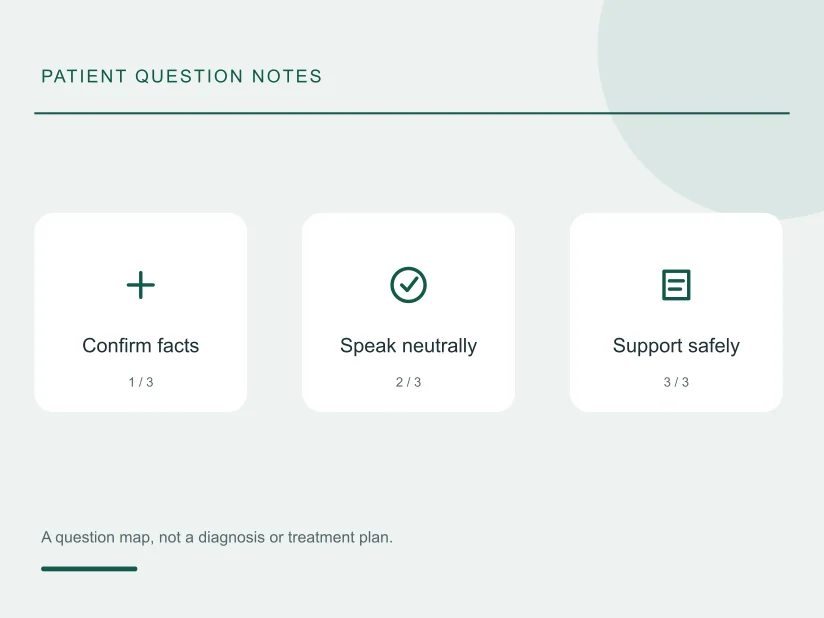
Clarify the facts before the conversation
Ask the treating professional which infection is confirmed, whether confirmation is pending and which partners should be informed. Request plain-language advice you can share accurately. Do not report a reactive screen as a final diagnosis if further testing is required, or promise a partner that symptoms alone establish when infection occurred.
Use a short, neutral message
You might explain that a clinician found an infection, that a partner may need medical advice, and that you can share the test name or relevant instructions. Keep the focus on next steps. Avoid accusations, public posts or forwarding private records to people who do not need them.
Separate your care from their prescription
A partner may need assessment even without symptoms, and their care may differ from yours. Do not share your medicine or assume one negative result makes review unnecessary. Ask the clinician about the relevant exposure period and what to do about sexual contact while each person’s assessment or treatment is being arranged.
Plan for safety and professional support
If you fear threats, violence or coercion, discuss this with the clinician before contacting the partner and seek appropriate local support. Ask what professional partner-notification help is available and what information would be shared. Do not assume anonymous notification exists locally or that a website can guarantee confidentiality under every circumstance.
Common questions
Does an STI result prove someone cheated recently?
Not by itself. Timing and interpretation differ by infection, so avoid conclusions beyond the clinical evidence.
Can my partner take part of my medicine course?
No. They need their own clinical advice and any indicated prescription. Sharing can leave both people inadequately treated.
Can this site send an anonymous notification?
This guide does not establish such a service. Ask the responsible clinician what local support is actually available.
Sources and information limits
Sources support general medical principles, not the UAE booking policies or service availability. Confirm instructions and local arrangements with the care provider. The update date does not claim clinician review.
Content policy and review statusQuestions before arranging an appointment?
Enquire about the next steps and availability. An enquiry does not confirm a booking or diagnosis and is not an emergency service.